This article explains the concept of Fault Tree Analysis (FTA) and its application as a risk management tool in projects. Risk Management is a very important part of a project and most project managers make extensive use of such risk management tools.
Introduction to Risk Management
Risk Management is one of the key areas of project management and is of increased importance in these volatile times to ensure successful completion of projects.
The various risk management alternatives available to a project manager in order to combat risk are
Avoid Risk,
Transfer Risk,
AdvertisementAssume Risk or
Prevent/Mitigate the risk.
Advertisement
In order to prevent or mitigate the risk, the manager makes use of such risk management tools.
Risk Management Tools – Fault Tree Analysis
Fault Tree Analysis is a risk management tool which takes undesirable events or faults and represents them in a tree like structure by a process of simple logic and graphical design. This helps us pinpoint the root causes or the lower level events which have resulted in this fault and thus enables us to take suitable actions to avoid or protect against it.
Please read this article to view the Steps involved in Risk Management .
A specific approach using Fault Tree Analysis is described below.
Steps Involved in Fault Tree Analysis
Define the undesirable events or failure in the project
Obtain a thorough understanding of the project
AdvertisementConstruct the fault tree
Evaluate the fault tree and identify corrective measures to be taken
Advertisement
- Implement these measures in order to protect against the hazards
Example of a Fault Tree Analysis
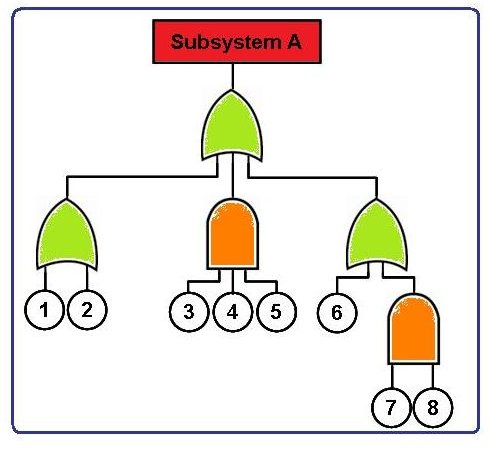
The below diagram represents a sample fault tree analysis
Here Sub-system A is the entire system which is being evaluated.
The green cells indicate a scenario where the presence of either cause will result in a fault. Either 1 or 2 will result in a fault. (OR Logic)
The orange cells indicate a scenario where the presence of all causes will result in a fault. (AND Logic)
All 3 causes 3, 4 and 5 need to present to result in a fault.
References
Managing uncertainty in projects is one of the tasks which most project managers overlook, and end-up paying a very high price at a later point in time.
A planned approach using Risk Management Tools such as Fault Tree Analysis (FTA) or FMEA (Failure Modes & Effect Analysis) can help avoid such pitfalls in project management.
An e-Book on Fault Tree Analysis can be obtained here.
A real life example of Risk Management using Fault Tree Analysis can be viewed here.