This article describes two diametrically opposite resource management techniques which can be used in companies and discusses the effectiveness of both in order to help determine which technique is a more suitable approach towards Effective Resource Management in Companies.
Introduction
This article discusses the merits and de-merits of both styles of management and also explains when each resource management technique can be implemented to achieve best results. It describes the potential impact of each style of management on the employees and also describes certain situations in which each style can be deployed to achieve best results.
Micro-Management
Micro-Management is a management style or a project management technique where a superior closely observes, monitors & controls the work of sub-ordinates. It is usually used in a negative / derogatory manner and characterizes a poor style of resource management.
Characteristics of Micro-Management:
Lower morale of employees
AdvertisementEmployees feel constricted
Consumes more of managers time
AdvertisementDiscourages initiatives and interaction
Meetings are not a priority
AdvertisementTeam communication is only top-down
When should you use Micro-Management?
Micro-Management is a technique which should best be avoided. It results in reduced performance in the long run. However, for a short term, if the employees lack the inherent capabilities, are extremely new to the job, then they may require a very large amount of guidance from the manager or if the task on hand is critical in nature and the associated risk of failure needs to be completely eliminated, it may necessitate a certain amount of micro-management.
Interface Management
Interface Management is a management style where a superior believes in the inherent capabilities of his employees and empowers sub-ordinates to a greater extent. Employees are given a certain amount of responsibility and freedom, and meetings are held where each employee is accountable for his sphere of responsibilities.
Characteristics of Interface Management:
Better employee morale
Employees feel empowered
AdvertisementSignificantly frees up managers time
Improves & encourages initiatives and interaction
AdvertisementMeetings become a priority
Team communication is both ways
Advertisement
When should you use Interface Management?
Interface Management is the technique which should ideally be adopted for the long run. It improves the overall working culture in the organization and will result in greater productivity from the employees. An employee needs to be recognized for his inherent capabilities and given due responsibility in order to ensure his long-term growth. This will help create an empowered organization.
Thus while Micro-Management can be applied in certain scenarios, it is more preferable to utilize interface management as it is better suited for effective resource management in companies .
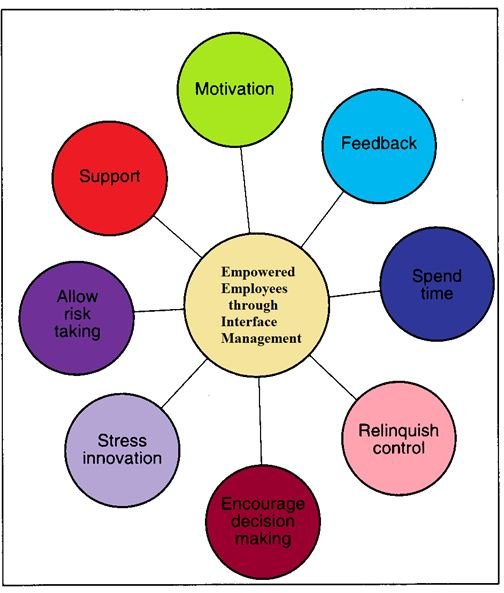
Empowering Employees through Interface Management
The following diagram denotes how employees feel empowered when an Interface Management style is used.