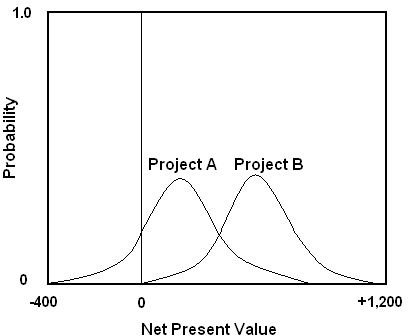
How do you compare NPV vs IRR? NPV or Net Present Value is a tool used to determine whether a project is worth the investments made. IRR or Internal rate of return is a formula used to calculate your investment’s profitability. Basically, it is the rate of return at which NPV is zero.
Overview of NPV and IRR
What is NPV?
NPV or Net Present Value is a measure used to determine whether a project is worth investing in. NPV compares the amount you have invested today with the present value of the expected future returns. Or in other words, it compares the amount you have invested today with the future returns after it has been discounted by a particular rate of return. NPV takes into account the principle in economics referred to as the “time value of money” which implies that a dollar earned today is more valuable than a dollar earned tomorrow.
To check the project feasibility using NPV, you must consider the minimum profit you would like to make. So, the value of NPV differs with different profit percentages. At some rates, the project would appear to be feasible and at others, it might appear to be non-feasible. Generally, NPV is used in conjunction with other factors to decide the project feasibility.
IRR or Internal rate of return is a formula used to calculate your investment’s profitability. Basically, it is an interest rate at which you can ensure that your investment makes more money than its actual cost. That is, it is the interest rate at which NPV becomes zero. If the actual discount rate is lower than IRR, then, the project is considered feasible.
NPV vs IRR - the Key Differences
IRR assumes that the cash flows are reinvested in the projected at the same discount rate. This is a major limitation for the use of IRR. NPV makes no such assumption.
NPV is measured in terms of currency whereas IRR is measured in terms of expected percentage return.
If NPV calculation uses different discount rates, then it produces different results for the same project. But, IRR always gives the same result. For the same reason, given a choice between NPV vs IRR, managers generally prefer IRR because it is easier and less confusing.
From a comparison of NPV and IRR, it can be seen that NPV is actually a better measure than IRR, especially, in long term projects, not only because NPV considers different discount rates but also takes into account the cost of capital.
Comparing NPV and IRR - with an Example
Take an example where an XYZ Company wants to buy a smaller company named ABC. XYZ finds out that the future cash flows generated by ABC, if discounted at a rate of 10% yields a present value of $20 million. If ABC is ready to be sold at $15 million, then, the NPV of the project would be $5 million. ($20 - $15 = $5). The $5 million dollar NPV is the value that would be added to XYZ company if it aquires ABC. Thus, there is a positive NPV. From the business perspective,if this value meets the minimum expected profits from a merger, then, XYZ can go for it.
But, the firm should also know the rate of return that would be generated by this investment. To calculate this rate of return, put the NPV factor to zero and calculate the unknown discount rate. This rate i the project’s internal rate of return. The value of IRR depends on the projected cash flows. Let us assume that in this example the value is 15%. Thus, XYZ company, has a project which has a 15% return. If XYZ company can undertake a project with a higher IRR, it can probably go for it since the yields would be higher.
Image Credit: Wikimedia Commons