Whether you need help with managing risks, allocating resources, making informed decisions or prioritizing goals, this one matrix has the answers to them all. Read on and find out how you can use this versatile tool for your project.
The Carver matrix, which has its roots in the Vietnam War, was developed by the U.S. Special Forces as a method to rank and prioritize the targets to be destroyed. Interestingly, the matrix has now become a popular concept in business and project management. In its new playfield, it finds use as a technique –
- To deploy and use resources more efficiently,
- To rank and prioritize goals and targets,
- To assess and manage risk, and
- To make decisions.
Let’s take a closer look at what this matrix is and how it is used. We also have a free Carver matrix template which can be downloaded from Bright Hub’s Media Gallery .
Elements of the Matrix
This matrix ranks every goal, task or risk across six parameters, which are:
Criticality: How important or critical is a particular factor to the overall objective of the project? What we’re trying to assess here is whether something is an absolute necessity or is it good to have but is not a necessity. You need to rank a factor based on how strongly it is needed to achieve the ultimate goal.
Accessibility: When ranking a factor for accessibility, you need to question - whether you can start it right away, are all the means needed for it readily available and are there other factors that need to be handled before beginning with the particular factor. If a task can be taken up only after some other task is completed, then the first task will score low on accessibility and the latter will score higher.
Return: This requires a factor to be ranked on how closer it gets you to the payoff. A factor which offers the shortest amount of time for the payoff, deserves a higher score.
Vulnerability: Vulnerability is how easy or difficult it is to achieve a goal or to complete a task. In addition to the level of difficulty, the associated cost also needs to be taken into account, for assigning a vulnerability score.
Effect: How will the achievement of a goal or the completion of a task effect the overall goal? Factors that will increase the likelihood of achieving the overall goal should be assigned a higher score.
Recognizability: How complex or easy is the task or goal? Things which are easily understandable and doable deserve a higher rank.
Preparing a CARVER Matrix
Let’s take an example to illustrate how a Carver Matrix can be prepared for prioritizing tasks associated with the setting up of a customer support centre. The key tasks identified for this project are –
- Networking
- Installation of hardware
- Installation of software
- Procuring work desks and office furniture
- Installation of the air-conditioning system
- Interior decoration
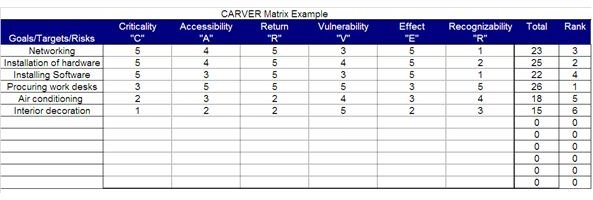
Now to construct the matrix we’ll list all these tasks in the first column. Here’s an image of the final matrix, which you can refer to as you read the explanations.
Criticality: Moving on to the next column, we need to assign each activity a criticality score. A quick look at the activities suggest that while networking, hardware and software are critical for the setting up of the call centre, air-conditioning and interior decoration don’t have any significant effect on the main objective.
Accessibility: You cannot have the computers setup until there are office desks for them, and you cannot have the software installed until the computers have been setup. Thus, the first task that can be done is to procure office furniture and that’s what earns this activity a higher score.
Return: The faster the networking and hardware & software installation take place, the faster will be the payback. The payback time doesn’t have much to do with the air-conditioning of the office.
Vulnerability: Procuring furniture for the office is certainly easy as compared to the technical tasks, and thus it gets a higher vulnerability score. Also, when we look at the cost, furniture is likely to be less expensive than networking or hardware.
Effect: Is the interior of the office going to help in meeting the project goal? It is the networking, hardware and software that will have a greater and stronger effect on the goal.
Recognizability: Of all the project activities, the easiest task to understand and do is to procure office furniture. The technical tasks are difficult to understand and do, so they score lower on this parameter.
With every activity assigned a score across the six parameters, we’re ready for the final task. Total the scores for each activity and finally rank the activities on the basis of the total scores. The higher the total, the higher the rank for a particular activity will be. In the example we’ve used a five point scale for scoring, but you can use a ten point scale for more accuracy. The template available at the above link will automatically total the scores and rank the activities as you fill in the individual scores.
Using the Matrix for Risk Management and Resource Allocation
The same CARVER matrix can be used for risk management and for the allocation of resources. To use it for the allocation of resources, you simply need to rank the tasks and then allocate the resources to various tasks based on their rank.
However, if you’re using it for risk management, here’s how to go about with the scoring.
Criticality – How severe will be the damage caused by the risk?
Accessibility – Is there a ready strategy to mitigate the risk? Are there other risks that need to be handled before addressing a particular risk?
Return – Will mitigating a risk help in achieving the goal sooner? Or, will it increase the payback?
Vulnerability – How easy is it to handle the risk? What is the cost of mitigating the risk?
Effect – Will removing the risk increase the chances of achieving the project’s objective?
Recognizability – Is the risk easy to understand and assess?
If you’re looking for sample forms and downloadable templates, check out Bright Hub’s resource guide Over 50 Free Project Management Templates and Sample Forms .
References & Credits:
- https://ufridman.org/blog/using-carver-to-identify-risks-and-vulnerabilities/
- https://www.stevepavlina.com/blog/2007/05/how-to-prioritize/
Image Credit:
Image by – Sidharth Thakur