Combined with PDCA cycle, also called the Deming Cycle, 5S ensures continuous quality improvement starting from the top of the corporate ladder.
Equally important to the first two terms of 5S discussed in a previous article, namely Seiri-Sort and Seiton -Systematize , are Seiso-Sweep, Seiketsu-Standardize and Shitsuke-Self-discipline.
Seiso: Sweep
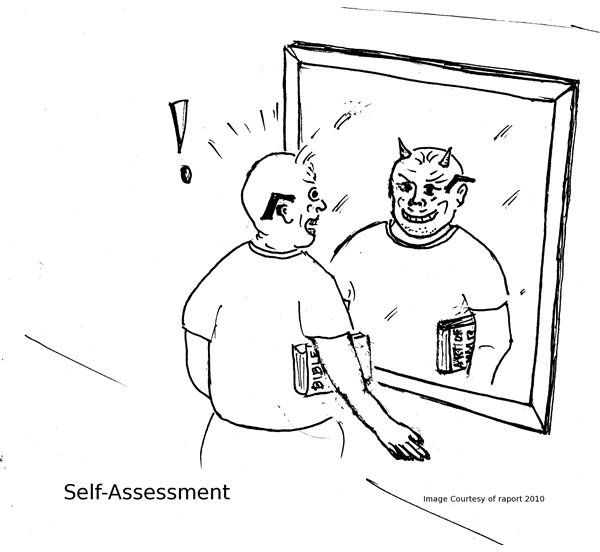
Managers need self-assessment not only of their skills and knowledge but especially of their attitude and mindset towards work. More often,
prejudices hamper the smooth implementation of projects and compromise the realization of organizational objectives.
To steer the organization towards clear and stable direction, it is necessary to clean up administrative cobwebs and strengthen the managerial core skills and competencies. Cleaning corporate stairs starts from the top; from Chief Executive Officers (CEO), Chief Operating Offices (COO), and down to line managers. This stage means attacking and resolving the causes of discrepancies at the source (of corporate order and command) that bog down improvement.
Seiketsu: Standardize
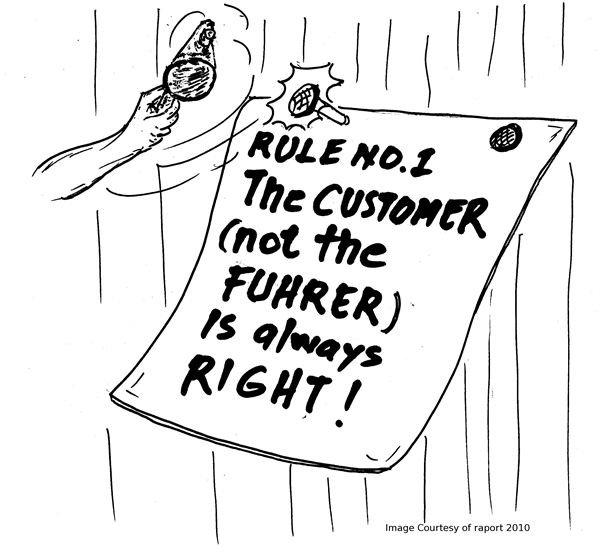
To employ the needed managerial core competencies and carry out systematic approaches, realizing desired results on time with the best quality and at lower cost, companies will do everything that it could take and outsmart competition.
But sustaining these abilities is the only thing that many of them fail to realize. The formula lies in standardization – fixing and sticking to the rules. The establishment of guidelines derived from the best practices of the the first three S’s provides an easy pattern for sustaining gained rewards.
Shitsuke: Self-Disicipline
Both an art and a branch of knowledge, management is a particular discipline to be adhered to. Commitment to this discipline requires the
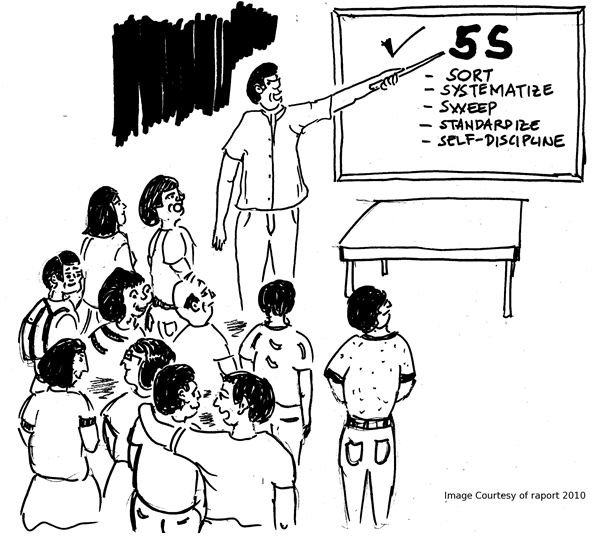
process of continuous improvement and development of new methods to promote business. Reorientation of people from the middle to the top of the corporate ladder is important. Learning ways to reassess their competence and to lead and motivate workers should not be optional but a requirement. Part of this discipline is to institute the implementation of training among managers on this learning.
PDCA Cycle and 5S
Combined with the Plan Do Check and Act (PDCA) cycle , 5S for Managers brings to completion a methodology which can promote continual management improvement or CMI. The Plan Do Check and Act (PDCA) cycle, also known as the Deming Cycle, coined after W Edwards Deming, one of the acclaimed quality gurus, is a model for kicking in continuous improvement in the work process. This is how CMI works.
Plan (P)
Seiri-Sort is applied. Without a well planned project, so much time, money and effort are wasted for correcting mistakes. Sorting out of inconsistencies in the goals and objectives, strategies and policies calls for strategic quality planning.
Do (D)
Actualizing the plan, Seiton-Systematize takes care of the effective techniques in accomplishing aspired outcome.
Check (C)
Checking is the task of monitoring and analyzing the process of implementing the plan, taking cognizance of what went wrong through measurable facts. The practice of Seiso-Sweep comes into play in this stage. Checking is equal to cleaning. If there is a medical check-up, there should also be management check-up, to help managers become fit, healthy and wise. Workers would like to work with healthy supervisors both mind, body and spirit. At this juncture, corrective actions are recommended for identified discrepancies.
Act (C)
Corrective actions from the previous stage are carried out here. By applying Seiketsu-Standardize, the best ways of doing work are undertaken to prevent recurrence of errors and delay.
Continual Improvement
Finally, PDCA cycle is a continual loop. Meaning, to perform again the Plan, Do, Check and Act stages on an agreed period at specified
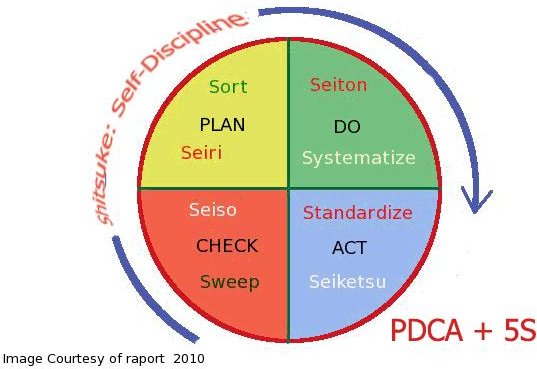
processes, to keep them on improving. This is the key to quality assurance – to keep things done right the first time and every time. And the best way to make it happen is through self-discipline: shitsuke, an unequivocal management commitment.
References
https://web.mit.edu/hr/oed/learn/leading/tool _assessment.html
https://www.sonic.net/~mfreeman/manage.htm
https://www.managementstudyguide.com/management _discipline.htm
https://www.visitask.com/PDCA-cycle.asp
Image Credits: raport